Sagging Two-Story Gutters: Causes, Dangers & Fixes
Sagging two-story gutters are more than an eyesore. Learn what causes long runs to pull away, when repairs are enough, and when it’s time for safe professional help.
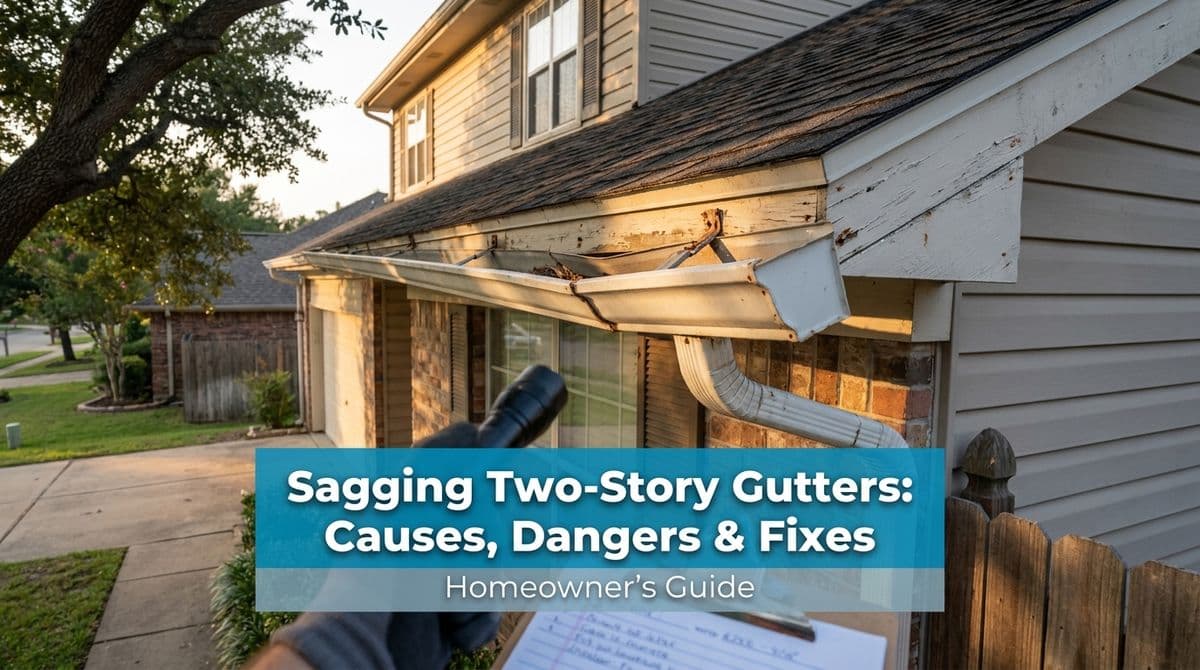
When a 70-Foot Gutter Starts to Pull Away
We recently got a call from a homeowner — let’s call him Tom — who was worried about a long seamless gutter on the back of his two-story house. The run was about 70 feet, two stories up, with a downspout on each end. After some heavy rain and snow over the holidays, Tom noticed the middle of the gutter was starting to come loose.
He told me, “I think it just needs to be cleaned, and the fascia and the gutter need to be re-screwed up there.” He also added, “Just be careful up on that ladder there, two stories up, okay?” and he was absolutely right to be thinking about safety.
If you’ve got a long gutter run on a two-story home that’s sagging or pulling away, you’re dealing with more than just an eyesore. Let’s walk through what usually causes this, what to look for, and how we decide if a simple fix will work — or if it’s time for replacement.
Why Long Seamless Gutters Start to Sag or Pull Away
On Tom’s home, the problem started in the middle of a 70-foot seamless gutter. That’s a huge span. Over time, several factors tend to gang up on these long runs:
1. Too Much Water, Not Enough Downspouts
Tom’s gutter had one downspout on each end. For a 70-foot run, that’s usually not enough. All that roof water has to travel a long way, and when it can’t get out fast enough, it backs up and adds weight.
- Longer run = more water collected.
- Only two exits (downspouts) means water sits in the middle longer.
- Backed-up water turns the gutter into a long, heavy trough.
On newer installs, we often add a third downspout on long runs like this, especially if the roof area feeding that gutter is large.
2. Clogged or Dirty Gutters
Leaves, needles, shingle grit, and ice can all build up in the gutter. When that debris gets wet, it’s like filling the gutter with wet sand. Add winter snow and ice, and the weight multiplies.
That extra weight slowly pulls on the fasteners and the fascia board. You don’t usually notice it day-to-day — until one day you step back and see the middle drooping or pulling away from the house.
3. Failing Fascia and Old Fasteners
Even if the gutter itself is fine, the fascia board or fasteners may be failing:
- Old spikes or undersized screws loosen over time.
- Rotten or soft fascia can’t hold screws tightly.
- Temperature changes cause expansion and contraction that slowly wiggles fasteners loose.
On two-story homes, these problems often go unnoticed for years because no one’s eye-level with the gutter to see the early signs.
Warning Signs Your Gutters and Fascia Are in Trouble
Before a gutter actually falls, it usually gives you some clues. Here are signs we tell homeowners to watch for:
- Sagging in the middle of a long run, especially after storms.
- Gaps between the gutter and fascia — you can see daylight behind the gutter.
- Nails or screws backing out or visible hardware pulling away.
- Overflowing water in the middle of the gutter, even in moderate rain.
- Stains or streaks on the siding below the sagging area.
- Soft or crumbling fascia if you can reach a lower section and gently probe with a screwdriver.
If you’re seeing one or more of these on a two-story gutter, it’s time to have it checked before wind, ice, or the next heavy rain makes things worse.
When Cleaning and Re-Screwing Is Enough
Tom was hoping we could simply clean the gutter and re-screw it, and sometimes that really is all that’s needed. Here’s when a basic repair is usually appropriate:
- The gutter itself is not dented, twisted, or cracked.
- The fascia boards are still solid (no rot, no softness).
- The gutter pitch (slope) can be adjusted so water flows to the downspouts.
- The fasteners are just loose or undersized, not ripped out with wood attached.
In those cases, we’ll typically:
- Clean the gutter thoroughly so we’re not hanging it back up full of weight.
- Inspect the fascia for hidden rot or damage.
- Replace old spikes with modern gutter screws or hangers spaced correctly.
- Adjust the slope and consider adding an extra downspout for long runs.
On a 70-foot run, adding that middle downspout can make a huge difference in long-term performance.
When It’s Time to Replace Gutters or Fascia
Other times, especially on older two-story homes, we find that simply re-screwing isn’t going to be a lasting fix. Replacement becomes the smarter option when:
- The fascia is rotted, soft, or crumbling.
- The gutter is bent, twisted, or permanently bowed from weight.
- Multiple sections are pulling away, not just one spot.
- You’ve had repeated repairs in the same area.
In those situations, we may recommend:
- Replacing fascia boards so fasteners have something solid to bite into.
- Installing new seamless gutters with the correct size and slope.
- Adding additional downspouts to reduce water load on long runs.
- Optionally adding gutter covers to reduce clogs and weight from debris.
It’s a bigger project, but it prevents water damage to your siding, foundation, and landscaping over the long term.
Why Two-Story Gutter Work Should Be Left to Pros
Tom’s last comment on the phone was, “Just be careful up on that ladder there, two stories up, okay?” Two-story gutter work isn’t just inconvenient — it can be dangerous.
Serious Height, Serious Risk
On a two-story home, you’re often 20–25 feet up, sometimes more. That’s well beyond the comfort zone for most household ladders and DIY work. The risks include:
- Ladder slip on uneven ground or wet surfaces.
- Overreaching on a tall ladder to access the middle of a long run.
- Handling long, heavy gutter sections while trying to balance.
As a contractor, we use proper ladders, stabilizers, and safety equipment, and we’re up there every day. For most homeowners, it’s just not worth the risk to save a few dollars.
What You Can Safely Do as a Homeowner
Even if you leave the high work to us, there are a few things you can safely do from the ground or a short step ladder:
- Visually inspect for sagging, gaps, and overflow during a rain.
- Check lower downspouts for clogs or disconnected joints.
- Look for water stains on siding or around the foundation after storms.
- Schedule regular cleanings or ask about gutter guards if you have heavy tree cover.
If you see a long seamless gutter on your two-story home starting to sag or pull away like Tom did, don’t wait for it to get worse. Have a professional take a look, check the load, the downspouts, the fasteners, and the fascia, and then give you a clear plan — whether that’s a simple clean-and-resecure or a more permanent replacement.